
刊行物


刊行物のご案内
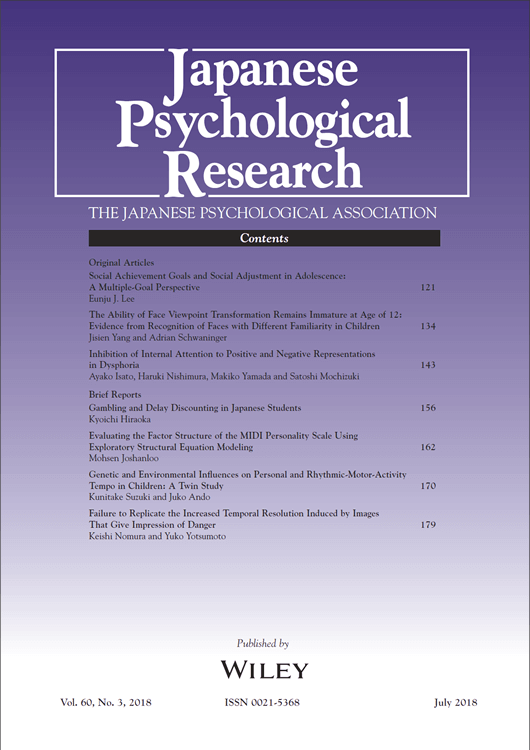
2028年刊行予定 Japanese Psychological Research 特集号 (Special Issues of JPR)
"Self- and Other-Directed Ageism" (自己および他者に向けられるエイジズム)一般公募について
See below for the English version.
- テーマ:
- "Self- and Other-Directed Ageism"
- (自己および他者に向けられるエイジズム)
- 編集者:
- 中川 威(大阪大学)
- 清水 佑輔(成城大学)
- 発行予定:
- Japanese Psychological Research Vol.70, No.1 (2028年1月号)
- 事前アブストラクト提出期限:
- 2026年6月30日
- 事前アブストラクト提出先:
- https://forms.gle/KLwTM1suuLVzU9dq5
- 投稿締切:
- 2026年11月30日
- 投稿先:
- https://www.editorialmanager.com/jpr-jpa/
エイジズム(ageism)とは,年齢を理由にした人々に対するステレオタイプ,偏見,差別を指し,主に若者から高齢者に対するステレオタイプ,偏見,差別に関する研究が行われてきました(Butler, 1969)。エイジズムは,世界中の組織や政策に浸透し,個人や社会に有害な影響を及ぼしていることが明らかになりつつあります。そのため,人々が平等に扱われる世界を実現するためには,エイジズムという社会課題の解決が不可欠です。実際,国連総会では,2021年から2030年までの10年間を「健康長寿の10年(Decade of Healthy Ageing)」とすることが宣言され,エイジズムの克服が世界共通の目標の一つとされています。
社会からの要請に応えるため,エイジズム研究は発展し,社会実装を目指しています。エイジズムの定義を踏まえると,どの年齢の人も偏見や差別の対象となる可能性があるため,高齢者から若者に対するステレオタイプ,偏見,差別,高齢者同士のステレオタイプ,偏見,差別といった多様な形態のエイジズムが明らかになっています。さらに,他者に向けられるエイジズム(other-directed ageism)だけでなく,自分自身に向けられるエイジズム(self-directed ageism)を理解しようとする試みも進んでいます。近年では,主観的年齢や加齢に対する自己認知などの従来の概念に加え,加齢に関する本質主義や加齢に係る変化意識などの新たな概念が提案されています。多くの研究者が,人々が自己や他者の加齢をどのように捉えるか,そうした加齢に対する見方(views on aging)がどのように互いの心理と行動に影響するかを解明し,エイジズムやステレオタイプを軽減することで社会課題を解決することに挑んでいます。
本特集では,心理学からのアプローチを基盤としつつ,自己および他者に向けられるエイジズムに関する論文を広く募集します。心理学的メカニズムや個人のウェルビーイングに関連する内容であれば,老年学,医学,社会学,教育学,情報学などの異なる学問分野との学際的研究の論文も積極的に受け付けます。具体的には,次の5つの観点に関連する論文の投稿を特に歓迎します。
- 1. エイジズムの概念と測定,他者に向けられるエイジズムと自己に向けられるエイジズムの関連
- 2. 若者から高齢者に対するステレオタイプ,偏見,差別という従来のエイジズムに留まらない多様な形態のエイジズム
- 3. エイジズムやステレオタイプが個人や社会にもたらす影響やそのメカニズム(職場,医療・福祉,SNSでの偏見や差別など)
- 4. エイジズムの軽減に資する介入(教育,世代間交流,キャンペーンなど)
- 5. 性別,人種,社会階層などの複合的な偏見や差別が交差するエイジズム(交差性)
調査や実験などの量的方法,面接や観察などの質的方法といった幅広い方法を用いた実証研究に留まらず,展望論文も受け付けます。多様なアプローチによるエイジズム研究の新たな地平を拓く論文の投稿をお待ちしています。
- ・本特集号への投稿を希望する方は,2026年6月30日までにアブストラクト(英文500 words以内)を以下フォームから送信してください(https://forms.gle/KLwTM1suuLVzU9dq5)。
- ・事前に提出いただいたアブストラクトに基づく採否の審査結果は,2026年7月31日までに通知されます。
- ・事前に提出いただいたアブストラクトが採択となった場合,執筆・投稿の手びきに従って論文原稿を作成し,2026年11月30日の締切までに投稿してください。審査を経て採択された論文は,2028年1月刊行のJapanese Psychological Research, Vol.70, No.1 に掲載される予定です。
- ・本特集号に関する編集者への問い合わせ(論文テーマの適否に関する相談を含む)は,中川 威(nakagawa.takeshi.hus@osaka-u.ac.jp)にお寄せください。
Call for Papers: Special issue of Japanese Psychological Research "Self- and Other-Directed Ageism"
- Title:
- "Self- and Other-Directed Ageism"
- Editors:
- Takeshi Nakagawa (University of Osaka)
- Yuho Shimizu (Seijo University)
- Publication:
- Japanese Psychological Research Vol.70, No.1 (January, 2028)
- Deadline for abstract submission:
- June 30, 2026
https://forms.gle/KLwTM1suuLVzU9dq5 - Deadline for full paper submission:
- November 30, 2026
- Submission:
- https://www.editorialmanager.com/jpr-jpa/
Ageism refers to stereotypes, prejudice, and discrimination against individuals based on their age (Butler, 1969). Research has primarily focused on stereotypes, prejudice, and discrimination from younger adults toward older adults. It is increasingly recognized that ageism is highly prevalent across institutions and policies worldwide, exerting harmful effects on individuals and society. Therefore, addressing ageism as a societal issue is essential to realizing a world where individuals are treated equally. In fact, the United Nations declared the decade from 2021 to 2030 the “Decade of Healthy Ageing,” making combating ageism one of the world's shared goals.
To respond to the societal demands, ageism research is advancing and aiming for social implementation. Given the definition of ageism, individuals of any age can be targets of prejudice and discrimination. Consequently, diverse types of ageism have been identified, including stereotypes, prejudice, and discrimination from older adults toward younger adults, as well as those among older adults themselves. Furthermore, research has advanced our understanding of both self- and other-directed ageism. Recently, in addition to existing concepts, such as subjective age and self-perceptions of aging, emerging concepts, including essentialist beliefs about aging and awareness of age-related changes, have been proposed. Many researchers are tackling societal issues by reducing ageism and stereotypes. They aim to elucidate how individuals perceive their own and others' aging, how these views on aging influence one another's minds and behaviors, and how to mitigate ageism and stereotypes.
This special issue invites articles on ageism directed toward the self and others from broader disciplines, particularly psychology. We seek articles from interdisciplinary perspectives that address psychological mechanisms or individuals’ well-being and integrate psychology with other disciplines, such as gerontology, medicine, sociology, education, and information science. In particular, this special issue will highlight articles addressing the following five topics, but not limited to:
- 1. The concept and measurement of ageism, and the relationship between self-directed ageism and other-directed ageism
- 2. Diverse types of ageism beyond classical stereotypes, prejudice, and discrimination from younger adults towards older adults
- 3. Consequences and mechanisms of ageism and stereotypes on individuals and society (e.g., prejudice and discrimination in the workforce, healthcare/welfare, and social media)
- 4. Interventions contributing to ageism reduction (e.g., education, intergenerational contact, campaigns)
- 5. Ageism intersecting with other types of prejudice and discrimination based on gender, race, social class, etc. (intersectionality)
This special issue invites empirical articles employing a wide range of methods—including quantitative approaches such as surveys and experiments, and qualitative approaches such as interviews and observation—as well as review articles. We look forward to studies that approach ageism in innovative and diverse ways.
- ・Authors who intend to submit a manuscript to the special issue should first submit an abstract (Max. 500 words) for consideration by June 30, 2026 through the following online form (https://forms.gle/KLwTM1suuLVzU9dq5).
- ・Submitted abstracts will be screened for acceptance, and the results will be notified by the 31st of July 2026.
- ・The full paper should be prepared following JPA Publication Manual and submitted by the deadline on the 30th of November 2026. The reviewed and accepted papers will be published in Japanese Psychological Research, Vol. 70 No. 1, scheduled for publication in January 2028.
- ・Inquiries about this special issue (including consultations on the suitability of the topic) should be emailed to Takeshi Nakagawa (nakagawa.takeshi.hus@osaka-u.ac.jp).